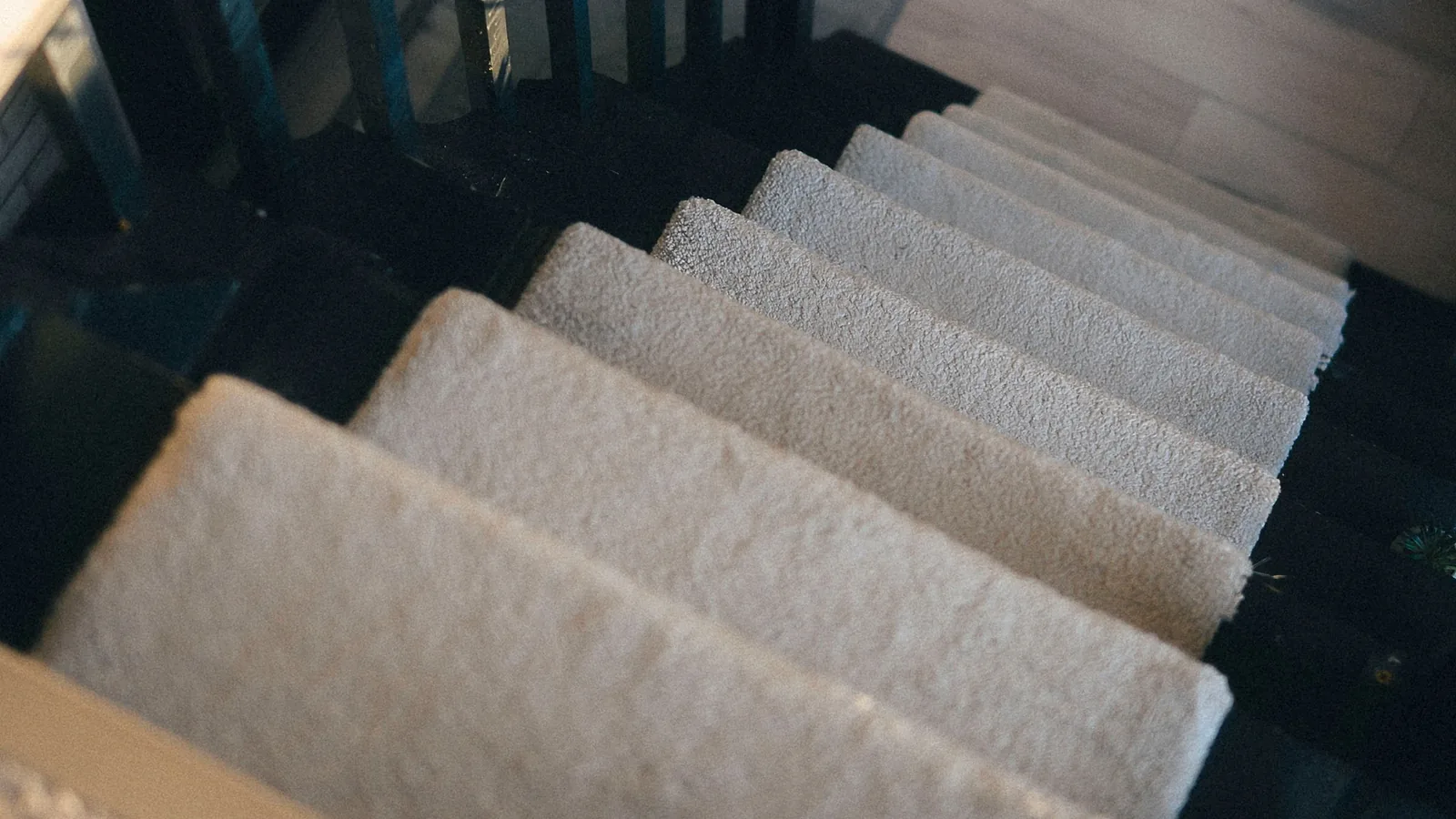
Every trip upstairs and back down goes over the same few square feet of carpet, and it all lands on the front edge of each tread. That's why stairs are usually the first carpet in a house to look worn — and why they're the place where the quality of the installation matters most.
There are two ways to carpet a stair. The waterfall method runs the carpet over the nose of each step and straight down to the next tread, leaving it loose over the riser. It's quick. The cap-and-band method — sometimes called upholstered or wrapped — pulls the carpet tight around the nose and tucks it under, then down the riser, so it follows the shape of every step. It takes longer, but it looks tailored, it doesn't gap at the riser, and it holds up better, which is why it's the method we recommend.
Pad matters more on stairs than anywhere else. Each tread gets its own piece of pad, cut to stop short of the edges, and it needs to be firm. A thick, soft pad feels nice in a bedroom, but on a stair nose it lets the carpet flex with every step, which wears it out faster and makes the stair feel unsteady.
The carpet itself should suit the job. Dense, lower-pile carpet wears better on stairs than a deep plush, and it's easier to wrap cleanly around the nose. Very thick carpet can make a tread feel narrow and rounded. If your stairs have a turn, a landing or an open side with spindles, those are all doable — each one just takes more measuring and hand work.
One more thing to check before you choose: if the floor at the top or bottom of the stairs is changing too — say, new vinyl plank downstairs — plan both at once. The transition at the base of the stairs and the edge at the top landing look far better when they're designed together than when one floor is fitted to the other after the fact.
We install carpet on straight runs, landings and turned stairs across Auburn, Kent, Puyallup, Bonney Lake, Spanaway and the rest of our area. Call Floors by Angel at (253) 417-3607 for a free measure and estimate.